

Why Most Marketing Strategies Fail
Many businesses focus only on getting traffic but ignore what happens after someone visits their website. They run ads, publish content, and attract users, but those visitors leave without converting. This happens because there is no structured funnel guiding users from awareness to purchase and beyond.
A full funnel marketing strategy solves this problem by creating a complete customer journey. Instead of random marketing efforts, it ensures every stage is connected and optimized for conversions, engagement, and long-term growth.
👉 Learn complete marketing foundation here:
The-best-ultimate-guide-to-digital-marketing-in-2026
What is a Full Funnel Marketing Strategy?
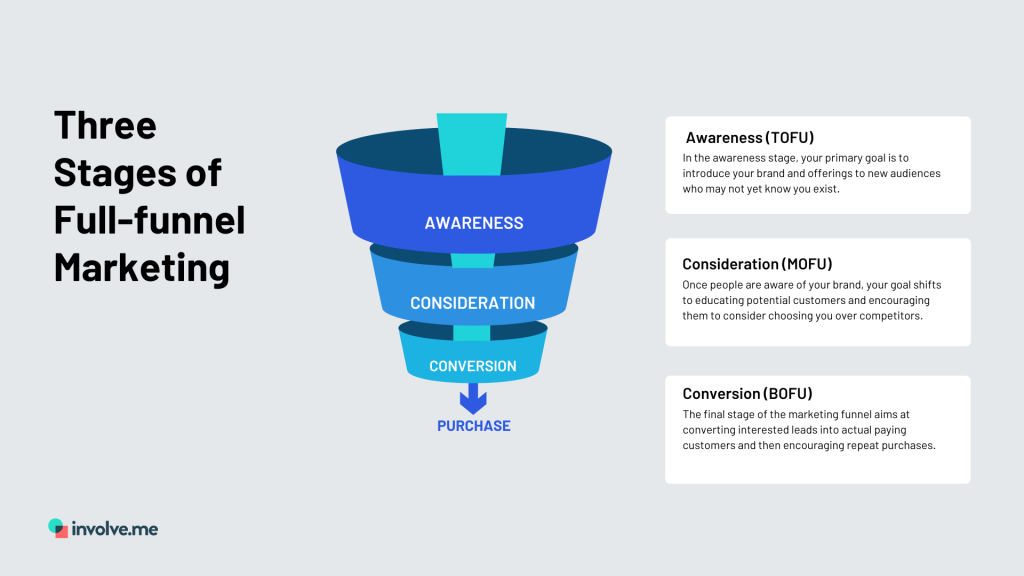
A full funnel marketing strategy is a system that targets customers at every stage of their journey—from discovering your brand to becoming repeat buyers. It focuses on three main stages: awareness, consideration, and conversion, followed by retention.
Unlike traditional marketing, which often focuses only on lead generation, this strategy ensures that every visitor is nurtured through a structured path. It helps businesses maximize the value of each visitor instead of constantly chasing new traffic.
The 4 Stages of a High-Converting Funnel
1. Awareness Stage (Top of Funnel Marketing Strategy)
At this stage, your goal is to attract new visitors who are not yet familiar with your brand. You create content that answers questions, solves problems, or provides value to your target audience. This includes blog posts, SEO content, social media, and videos.
The focus here is not selling but building trust and visibility. By targeting the right keywords and topics, you can bring consistent traffic to your website and introduce your brand to potential customers.
2. Consideration Stage (Middle of Funnel Marketing Strategy)
In this stage, visitors are aware of your brand but are still evaluating their options. They are comparing solutions and looking for more detailed information. This is where you provide guides, case studies, product comparisons, and email content.
Your goal is to build trust and position your business as the best solution. Providing valuable and informative content helps users move closer to making a decision.
3. Conversion Stage (Bottom of Funnel Marketing Strategy)
This is the stage where visitors take action—such as signing up, booking a call, or making a purchase. Your focus should be on removing friction and making the process simple.
Landing pages, clear calls-to-action, testimonials, and limited-time offers can significantly improve conversions. At this stage, your messaging should be direct, benefit-focused, and persuasive.
4. Retention Stage (Post-Purchase)
Most businesses ignore this stage, but it is critical for long-term growth. Retention focuses on keeping customers engaged after their first purchase.
Email marketing, follow-ups, loyalty programs, and personalized offers help build long-term relationships. Retaining customers is more cost-effective than acquiring new ones and leads to higher lifetime value.
Tools That Power a Full Funnel Marketing Strategy
To implement a successful funnel, you need the right tools for each stage. These tools help automate processes, track performance, and improve efficiency.
👉 Explore essential tools here:
digital-marketing-tools
For advanced automation and AI-powered marketing:
Using the right combination of tools ensures your funnel runs smoothly and delivers consistent results.
Simple Full Funnel Workflow
A practical funnel strategy connects all stages into one system. Instead of treating marketing as separate activities, you build a flow that guides users step by step.
- Attract traffic through SEO and content
- Capture leads using landing pages
- Nurture leads with email sequences
- Convert users into customers
- Retain customers through follow-ups and offers
This structured workflow ensures that no opportunity is wasted.
Common Funnel Mistakes to Avoid
Many businesses struggle because they do not optimize their funnel properly. One common mistake is focusing only on traffic and ignoring conversions. Others fail to nurture leads or build relationships with customers.
- No clear funnel structure
- Weak or unclear calls-to-action
- Ignoring email marketing
- Not tracking performance
Avoiding these mistakes can significantly improve your marketing results.
Final Thoughts
A full funnel marketing strategy is not just about getting traffic—it’s about guiding users through a complete journey. From awareness to retention, every stage plays a crucial role in business growth.
When you build a connected system, your marketing becomes more effective, predictable, and scalable. Instead of chasing new leads constantly, you create a process that turns visitors into loyal customers and drives long-term success.
FAQs
What is a full funnel marketing strategy?
It is a marketing approach that targets customers at every stage of their journey, from awareness to conversion and retention.
Why is full funnel marketing important?
It helps businesses maximize conversions and customer value instead of focusing only on traffic.
Which stage is most important in a funnel?
All stages are important because they work together. However, conversion and retention often have the biggest impact on revenue.
Can small businesses use full funnel marketing?
Yes, even small businesses can implement this strategy using simple tools and content marketing.
How long does it take to see results?
Results depend on strategy and execution, but consistent efforts usually show improvements within a few months.